
What is CE Marking and Why It Is Mandatory
CE marking is a legal declaration that a product complies with all applicable European Union (EU) directives and regulations. It indicates that the product meets essential health, safety, and environmental requirements, allowing it to be sold freely within the EU market. CE marking is mandatory for products covered by EU legislation, including machinery, medical devices, toys, electronics, construction products, and personal protective equipment.
By affixing the CE mark, the manufacturer confirms that the product has undergone the required conformity assessment, meets harmonised European standards, and has all the necessary technical documentation to demonstrate compliance. This protects consumers, ensures product safety, and allows for smooth trade across EU member states.
Who Needs CE Marking
CE marking is required for a wide range of economic operators in the EU supply chain:
Manufacturers – Responsible for designing, producing, and declaring product conformity.
Importers – Must ensure that non-EU products comply with EU directives before placing them on the market.
Distributors – Required to verify that products they handle carry CE marking and are safe for use.
Every party has a legal obligation to ensure CE compliance, reducing risk of penalties, recalls, or market restrictions.
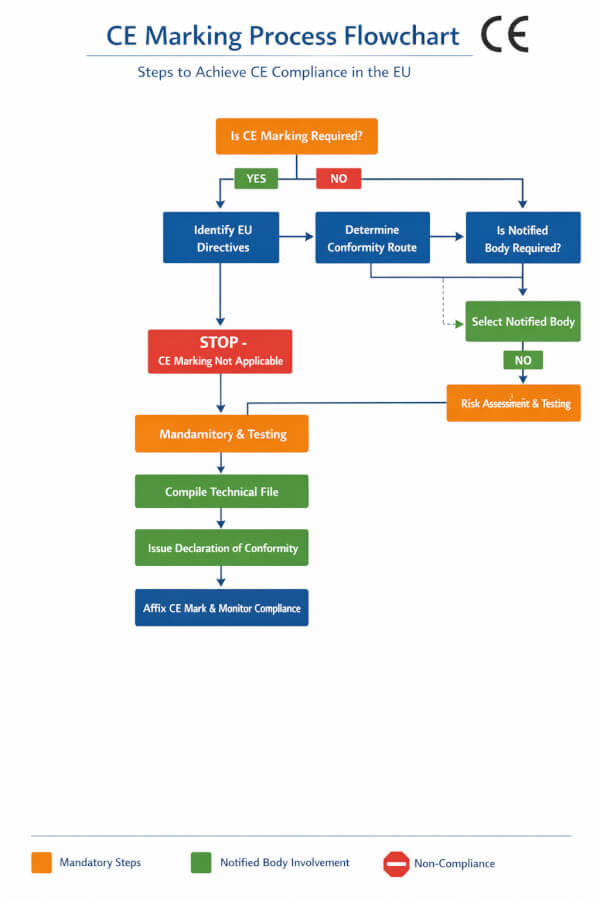
Interactive CE Marking Step-by-Step Guide
Click each step below to understand exactly what is required to legally apply CE marking to your product.
Step 1: Is CE Marking Required for Your Product?
CE marking applies only to products covered by EU harmonisation legislation such as Machinery, EMC, LVD, MDR, Toy Safety, PPE, and Construction Products.
If no EU directive applies, CE marking must not be affixed.
Step 2: Identify All Applicable EU Directives
A product may fall under more than one EU directive or regulation. All applicable legal acts must be complied with.
Missing one applicable directive invalidates CE marking.
Step 3: Determine the Conformity Assessment Procedure
EU legislation defines how conformity must be assessed. Depending on the product, this may involve:
- Internal production control
- Accredited laboratory testing
- Notified Body involvement
Step 4: Is a Notified Body Required?
High-risk products may require mandatory Notified Body involvement, such as certain medical devices, PPE Category III, or listed machinery.
Step 5: Apply Harmonised EN Standards
Applying harmonised EN standards provides presumption of conformity with EU legislation and simplifies compliance.
If EN standards are not applied, alternative technical solutions must be justified.
Step 6: Perform Risk Assessment and Testing
Risk assessment and testing verify that the product meets essential health and safety requirements.
Testing must be performed by accredited laboratories where required.
Step 7: Compile Technical Documentation
The technical file must include product description, risk assessment, test reports, standards applied, and instructions.
Documentation must be retained for at least 10 years.
Step 8: Issue the EU Declaration of Conformity
The Declaration of Conformity is a legally binding document signed by the responsible economic operator.
An incorrect declaration invalidates CE marking.
Step 9: Affix CE Marking & Maintain Compliance
Once all requirements are fulfilled, CE marking may be affixed.
Post-market surveillance obligations continue throughout the product lifecycle.
* CE marking is a legal requirement only for products covered by specific EU legislation. Products outside those directives must not bear the CE mark.