
I’ve seen this mistake more times than I can count.
A company buys an important standard. One PDF. One licence. And suddenly it’s emailed, uploaded to shared drives, copied into folders, and passed around like an internal memo. Everyone means well — but legally? It’s a ticking time bomb.
Sharing purchased standards is allowed, but only if you do it the right way. And if you don’t, the legal and financial risks can be far bigger than most companies realise.
Let me walk you through how to do it properly — with real examples, practical tips, and honest opinions from someone who’s seen both sides.
First: Understand What You’re Actually Buying
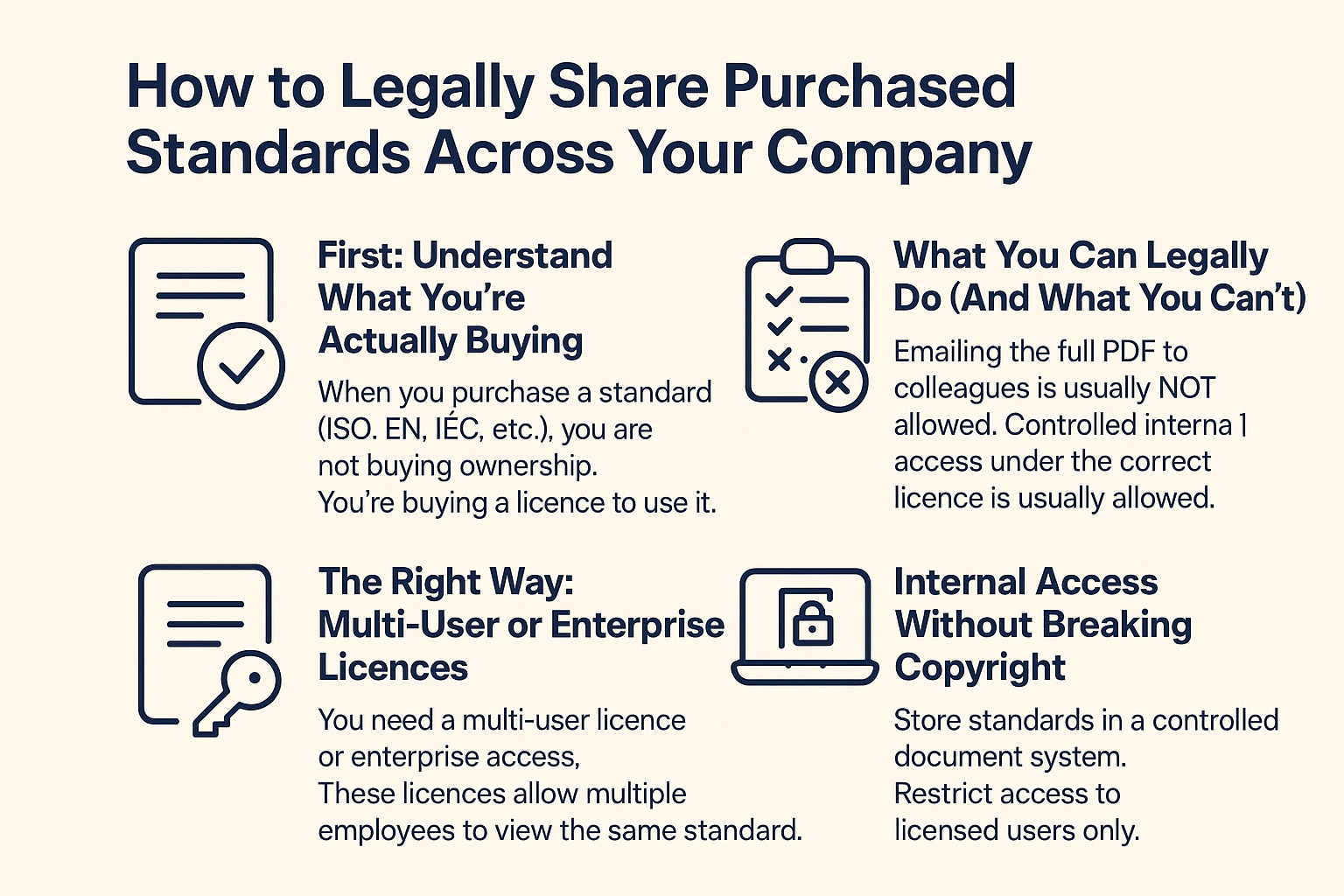
When you purchase a standard (ISO, EN, IEC, etc.), you are not buying ownership. You’re buying a licence to use it.
That licence defines:
- Who can access it
- How many users are allowed
- Whether copies are permitted
- If internal distribution is restricted
Most standards are published by organisations like International Organization for Standardization, and they are protected by copyright just like books or software.
My opinion: This is where most compliance problems start — not with bad intent, but with bad assumptions.
What You Can Legally Do (And What You Can’t)
Let’s make this very clear.
❌ What is usually NOT allowed
- Emailing the full PDF to colleagues
- Uploading standards to shared drives or intranets
- Printing multiple copies from a single-user licence
- Sharing standards with contractors or partners
✅ What is usually allowed
- Controlled internal access under the correct licence
- Referencing clauses without reproducing full content
- Training employees on requirements (not distributing text)
- Centralised access via approved platforms
The key word here is licensing, not sharing.
The Right Way: Multi-User or Enterprise Licences
If more than one person needs access, the solution is simple — but often ignored.
You need a multi-user licence or enterprise access.
These licences allow:
- Multiple employees to view the same standard
- Access from different departments
- Auditable usage tracking
Yes, they cost more upfront. But they cost far less than:
- Legal disputes
- Compliance failures
- Reputation damage
Honest take: If a standard is critical to your operations, treating it like a disposable PDF is reckless.
Practical Example: Engineering vs Quality Teams
Let’s say:
- Engineering needs ISO technical requirements
- Quality needs audit and compliance clauses
- Procurement needs supplier-related sections
Wrong approach: One person buys the standard and shares it internally.
Correct approach: One licence with controlled access for all relevant teams.
You stay legal, everyone stays informed, and audits become smoother.
Internal Access Without Breaking Copyright
Here’s a smart and legal workaround many companies use:
- Store standards in a controlled document system
- Restrict access to licensed users only
- Disable downloads if required
- Log access for audits
This works especially well for regulated industries where traceability matters.
My view: If your compliance system can’t manage licensed documents properly, the system is the problem — not the standards.
Training Is Not the Same as Distribution
This is important and often misunderstood.
You can:
- Create internal training materials
- Explain requirements in your own words
- Use summaries, flowcharts, and checklists
You cannot:
- Copy-paste large sections of the standard
- Reproduce tables or annexes verbatim
Smart companies translate standards into processes, not PDFs.
What About Auditors and External Consultants?
Another common trap.
Auditors usually:
- Bring their own licensed copies
- Reference clauses without distributing content
If an auditor asks for your internal copy, that’s a red flag — for them, not you.
Rule of thumb: Never share your licensed standards outside the organisation unless the licence explicitly allows it.
Why This Matters More Than Ever
With increasing focus on compliance, intellectual property, and governance, standards publishers are becoming stricter — and audits more frequent.
Companies that ignore licensing:
- Risk financial penalties
- Undermine their compliance credibility
- Look careless during audits
Companies that do it right:
- Move faster
- Train better
- Pass audits with confidence
Compliance Starts With Respect
Standards exist to improve quality, safety, and trust. Ignoring their licensing rules contradicts everything they stand for.
If a standard matters enough to guide your business, it matters enough to license properly.
Do it once. Do it right. And turn compliance into a strength — not a silent risk.