

If your business manufactures, imports, or distributes industrial machinery in the European Single Market, the clock is ticking. On January 20, 2027, the transition period for the EU Machinery Regulation (EU) 2023/1230 officially expires. On that day, the long-standing Machinery Directive 2006/42/EC will be permanently repealed, leaving no overlapping grace period.
For compliance teams, 2026 is not a year for passive planning; it is the ultimate execution window. This regulation is not simply a cosmetic update of the old directive. It is a complete rewrite of machine safety for the digital, connected, and AI-driven industrial era. If you wait until late 2026 to align your risk assessments, software architectures, and technical files, you will hit a wall of bottlenecked Notified Bodies, stalled supply chains, and market-entry blocks.

Integrating physical safety and cybersecurity under the new EU Machinery Regulation. Fuente: Bureau Veritas Cybersecurity
From Directive to Regulation: Why 2026 Is a Tectonic Shift
The most critical legal change is right there in the title: it is a Regulation, not a Directive.
Under the old Machinery Directive 2006/42/EC, each of the 27 EU member states had to transpose the rules into their own national laws. This created minor local deviations, varying enforcement standards, and administrative friction.
As a Regulation, (EU) 2023/1230 applies directly and identically across all EU member states. There are no national legal updates or local interpretations. From Berlin to Barcelona, every manufacturer, importer, and market surveillance authority is working off the exact same statutory text.
This direct applicability means enforcement will be faster, sharper, and far more automated. Surveillance authorities are already gearing up to use digital screening tools to rapidly flag non-compliant machinery, leaving legacy systems with nowhere to hide.
The Four New Pillars of Machine Safety
The new regulation recognizes that modern industrial machinery is no longer just a collection of steel gears, hydraulic valves, and electrical relays. Today’s machines are software-driven, cloud-connected, and increasingly autonomous.
To address this, the Regulation introduces four highly disruptive pillars that require immediate engineering attention in 2026:
1. Cybersecurity as an Essential Health and Safety Requirement (EHSR)
Historically, cybersecurity was treated as an IT or operational network issue. Under the new Regulation, cybersecurity is now a direct, legally mandated safety requirement.
Specifically, Annex III mandates that the safety-related control systems of machinery must be designed to resist both accidental failures and deliberate external interference (hacking, unauthorized firmware updates, or physical tampering via USB).
- The Rule: A cyber-attack or software corruption must never cause a machine to enter an unsafe state or disable a physical safety function.
- The Practice: Your engineering team must show a clear “secure-by-design” methodology, implementing strict access control, secure default configurations, and encrypted communication protocols.
2. Artificial Intelligence and the “High-Risk” Bottleneck
If your machine relies on self-evolving algorithms or machine learning to manage safety-related functions (such as an autonomous mobile robot dynamically calculating safe stopping distances), it is now categorized under Annex I (High-Risk Machinery).
- The Cost of Self-Declaration: Under the old directive, manufacturers could self-declare CE compliance for almost all machinery.
- The New Reality: Under the Regulation, Annex I products utilizing AI for safety functions require mandatory third-party conformity assessment by a certified Notified Body. Because of the severe shortage of Notified Bodies across Europe, booking these audits during 2026 is critical to prevent product launch delays.
3. The “Substantial Modification” Trap
Many companies believe they only need to worry about the new rules when designing brand-new machine models. This is a highly dangerous compliance misconception.
The Regulation introduces a formal legal definition for Substantial Modification. If you modify an existing machine after it has been placed on the market (for example, by retrofitting an older CNC machine with automatic loading robots, upgrading control system software, or swapping manual guards for light curtains), you may legally become the “manufacturer” of that entire machine.
- If the modification creates a new hazard or increases an existing risk in a way that requires new physical or digital protective measures, you must carry out a completely new risk assessment and re-issue the CE mark under the 2027 regulation.
4. Digital-by-Default Documentation
In a welcome move toward sustainability, manufacturers are now allowed to provide operating instructions and EU Declarations of Conformity in digital formats (such as QR codes on the machine pointing to a secure server or cloud folder).
- The Catch: The digital documentation must remain accessible and downloadable for at least 10 years after the machine is placed on the market. Additionally, if an end-user requests a paper manual at the time of purchase, you must provide it free of charge within one month.
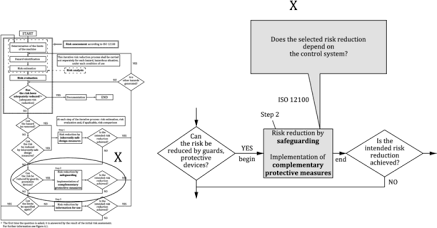
Technical Integration: ISO 12100 and ISO 13849-1
The technical blueprint for achieving compliance under the new Regulation rests heavily on two harmonised standards: EN ISO 12100 (risk assessment) and the newly updated EN ISO 13849-1:2023 (functional safety).
As illustrated in the risk assessment flowchart above, designers must follow an iterative process:
- Identify Hazards: Evaluate every operational phase of the machine (installation, operation, maintenance, decommissioning).
- Determine Control Dependence: If a risk cannot be designed out physically, you must evaluate if risk reduction depends on a safety-related control system.
- Validate Safety Functions: Under EN ISO 13849-1:2023, you must calculate and prove the Performance Level (PL) of your safety loops, ensuring that software, sensors, and actuators work together to maintain safety.
Under the new Regulation, this validation loop must explicitly include cyber-resilience testing. A control system can no longer achieve a high Performance Level if its digital interface is vulnerable to simple network flooding or unauthorized software modification.
Harmonised Standards: Your Technical Safe Harbor
To gain a “Presumption of Conformity”—the legal status where regulators assume your machine is safe because you followed recognized technical rules—you must design according to the latest versions of European Harmonised Standards.
Using outdated standards is now a major compliance violation. The table below outlines the core standards you must obtain, update, and implement during your 2026 transition:
| Standard Reference | Core Technical Focus | Why It Matters for (EU) 2023/1230 Compliance |
|---|---|---|
| EN ISO 12100 | General principles for design, hazard identification, and risk assessment. | The baseline starting point for your entire technical file. It must now be expanded to assess cybersecurity and digital manipulation risks. |
| EN ISO 13849-1:2023 | Functional safety of safety-related parts of control systems (SRP/CS). | Addresses the software, firmware, and logic of safety functions. Crucial for verifying that system logic cannot be corrupted by external networks. |
| EN IEC 62061 | Functional safety of electrical, electronic, and programmable electronic control systems. | Alternative or complementary to ISO 13849-1. Crucial for complex, highly automated production lines and complex programmable logic. |
| EN IEC 60204-1 | Electrical equipment of industrial machines. | Sets the physical electrical safety, wiring, grounding, and control cabinet standards required to pass basic electrical audits. |
| IEC 62443 Series | Industrial communication networks – Network and system security. | While technically an IT/OT security standard, it is the primary framework being adapted by CENELEC to prove compliance with the cybersecurity mandates of Annex III. |
2026 Action Plan: How to Prepare Your Engineering Team
To ensure you are fully prepared before the January 20, 2027 enforcement cliff, your engineering and regulatory affairs departments should implement the following structural transition:
1.Conduct a Machine Portfolio Audit:Q1 2026.
Identify every machine model you plan to sell or import in 2027. Classify them according to the new Annex I high-risk list to determine if you will need third-party Notified Body testing.
2.Perform Gap Analysis on Existing Risk Assessments:Q2 2026.
Review your current technical files built under the old Machinery Directive. Add specific hazard analyses for software security, remote connectivity, and human-robot collaboration scenarios.
3.Secure the Latest Harmonised Standards:Ongoing.
Ensure your engineering teams are designing to the actual, current versions of the standards (such as EN ISO 13849-1:2023). Purchasing individual licenses for your team legally via platforms like Genorma.com is critical to maintaining a clean audit trail.
4.Re-engineer Safety Control Architectures:Q3 2026.
Update machine control systems to meet the cybersecurity requirements. Implement physical protection for local ports (USB, ethernet), secure wireless protocols, and structured software update pathways.
5.Establish a Digital Documentation Registry:Q4 2026.
Build a reliable, long-term cloud infrastructure to host your digital operating manuals and EC Declarations of Conformity. Set up internal fulfillment workflows to print and deliver paper manuals within 30 days if requested by clients.
The Compliance Cost of Waiting: In previous regulatory transitions (such as the Medical Device Regulation), the biggest bottleneck was not technology — it was the availability of testing laboratories and Notified Bodies. If you wait until the end of 2026 to book your conformity assessments, you face the very real risk of being forced to halt sales on January 20, 2027, purely because of administrative backlog.
Compliance as a Competitive Edge
The transition from the Machinery Directive to the Machinery Regulation is undeniably demanding. It forces mechanical engineers to think like cybersecurity professionals, and software developers to think like functional safety experts.
However, companies that treat 2026 as a proactive transition year will gain a profound competitive advantage. While competitors struggle to update legacy equipment and wait in line for Notified Body approvals, compliant manufacturers will continue to place products seamlessly onto the market, enjoying uninterrupted access to the world’s most lucrative trading zone.
Ensure your engineering teams have access to the legal, official, and fully updated EN and ISO standards required to build your technical files. Visit Genorma.com to search for, purchase, and manage the standards that will secure your market access in 2027 and beyond.